New hard copy subscriptions

NEW SUBSCRIPTIONS Our November issue was mailed to subscribers on Thursday 1st October.

If you’d like a new hard copy subscription, as long as we receive your order by or on 1st November, it will start with our December magazine and be mailed to subscribers on Thursday 5th November.

INTERNATIONAL SUBSCRIPTIONS We’re sorry that we’re unable to send hard copy back issues outside the UK mainland, so please buy a downloadable version in the shop.

UK SUBSCRIPTIONS If you’d like to start with an earlier magazine, please buy it as a back issue and you’ll find lots of choice in our shop. UK readers please note At present, we can only send back issues to UK mainland addresses.

NEW DIGITAL VERSION From the January 2023 issue, you can now buy the digital version of the magazine. Just head for the SHOP and select either the hardcopy or downloadable option. The downloadable magazine is just £4 (sterling) for each issue and available straight away. It saves the huge expense and wait for overseas postage, so check it out NOW at machineknittingmonthly.net/shop/ Please note that, as yet, we don’t have a digital subscription available.

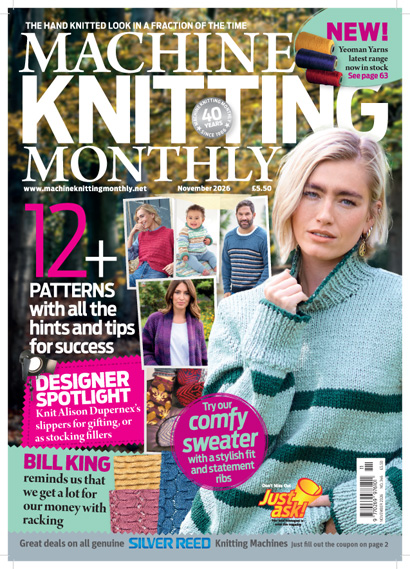
November 2026 (Issue 346) with Alison Dupernex, Bill King and Nina Miklin

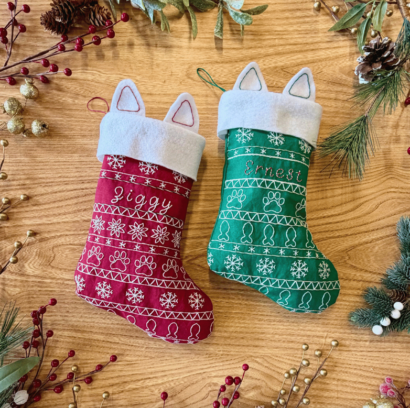
Every wardrobe needs a comfy sweater and our November 2026 cover design is this season’s go-to with a stylish fit and statement ribs. It’s in our monthly mix of patterns for standard, mid-gauge and chunky machines. Head for your stash to knit a pair of Alison Dupernex slippers for gifting, travelling or as stocking fillers and Nina Miklin’s classic relaxed fit gilet is a superb bodywarmer in Merino Wool and Mohair. Bill King continues his theme of ‘less is more’ and reminds us that we get a lot for our money with racking. Susan Guagliumi’s expertise lives on in the Machine Knit Community and look out for Susan’s new book, on sale soon. Our newest contributor, Lidia Higson knits basic buttonholes and Joan Lafferty is confined to quarters, but we doubt she’s sitting on her fingers! Our 64 colour pages are packed with techniques and help, advice, news and reviews.

Please note At present, we can only send back issues to UK mainland addresses. Otherwise, please buy the high-quality downloadable version that’s available worldwide.

October update

Dear Readers

The clocks going back at the end of October is a sure sign that Autumn has arrived. Christmas will be here before we’ve time to turn round, so we need to start thinking about knitting gifts. If you turn to Page 9, you’ll find a feature on some of the knits and looks we’ll find in shops and online for the coming season. Most of us need to spend wisely right now, as well as layer up to keep warm in the coming months. Our machines and stash could become our best friends for a few weeks. If you need more convincing, look around you at the cost of today’s bought knitted items and it can be eye-watering.

Whether it’s hand or ankle warmers, pull-on hats, skinny scarves or basic stocking stitch tops, even beginners can knit some incredible on-trend things. Most of this season’s knitting is plain stocking stitch with some rib. The colour span is from pastels to bold brights and the knitting is soft and cosy with a touch of wool or luxurious cashmere. Rib trims and high necklines keep in the warmth. Triangular scarves tie round the neck or drape over the shoulders to add an extra layer of warmth.

The look to go for in sweaters has an easy fit and if it’s casual wear, it’s straight and long… especially the sleeves. Turn to Page 16 and use the measurements on the diagrams of Band Width as a guide. Feed them into your charting device and the job’s done for you. Knit a classic scarf about 140 to 200cm long for an adult and 15 to 25cm wide. Often we use the height of a person as a rough guide for a scarf length, plus their hand span for the width. The first thing a machine knitter learns is to knit stocking stitch and most of us have a stash. Put them to good use and you’ve a couple of months to make friends and loved ones very happy!

NEXT ISSUE December 2026

Subscription copies sent out Thursday 5th November

On sale Thursday 12th November

Ask your newsagent to reserve a copy – see Page 61

Plainly silly?

Dear Anne

Please don’t print my full name, as I need to confess that I have bingo wings… big ones. I do like a bit of shaping on a sleeve, but I’m now having to resort to knitting straight sleeves and gathering them into the cuff. I feel as if I’m turning every cardigan into a bed jacket and it’s really getting me down. Have you any suggestions, please? I’ve come back to machine knitting after a long break, so I don’t really know who to ask. Yours sincerely, Mary

Please don’t worry Mary and let’s see what we can do. Many older-type sleeve patterns, especially the shapes for charting devices, increase the sleeve right up to the armhole level and then immediately start to shape the sleeve top. This is plainly silly! You don’t do all the work to get to the required upper arm width and then start to lose it straight away. Aim to knit at least 5 to 8 cm straight before starting to shape the top but, for yourself, you may need more. This will need the decreases altering, but one simple way is to put on say four more stitches at the cuff. (The rib will pull in this slight extra width.) If you’re increasing one stitch every tenth row, you’ll gain an extra 20 rows and double this if you add eight extra stitches. If the increases are every eighth row, you’ll gain 16 or 32 rows, either of which will give you a nice chunk of straight rows before shaping the sleeve head.

Sinking feeling

Hi Anne

I really like the Anne Baker Karabee patterns. She’s so good with baby designs and they always fit really well. My one big problem is that I don’t know how to cast off behind the sinker posts. Can you tell me how to do it please? Kind wishes, Wendy

Thanks for asking Wendy and here’s the method.

Step 1 Starting at the same end as the carriage, use a single transfer tool and take the end stitch off the needle.

Step 2 Take the stitch behind the sinker post and place the eye of the transfer tool onto the hook of the next needle. Bring the needle a short way out so that the stitches are behind the latch of the needle.

Step 3 * Take the yarn around the hook of the needle and pull the needle back so the yarn goes through both stitches behind the latch.

Step 4 Now take this stitch behind the next sinker post and onto the next needle. Again, leave the needle out a short way so the stitches are behind the latch of the needle.

Step 5 Repeat from * until you’ve cast off all the stitches required, then release the stitches from around the sinker posts. This method is excellent for casting off under the arm and has a small amount of stretch.

Remember one thing, though. Before you start to knit, think carefully about the best technique you should use on certain areas of your garment. One of Anne Baker’s favourite techniques was her sinker post cast off, but it might not be your forte. Have you ever felt that a garment you’ve made could have looked better if you’d done something different? Choose the method you like, that you know you can do well. Making a lovely finished garment is far better than sticking slavishly to the exact detail on a knitting pattern!

Autumn workshop

If you’ll be in travelling distance, the SMKA Autumn Workshop at Parklands Centre in Alva takes place on Saturday 17th October. It’s not far from the M80/M9 and seven miles from Stirling. Members and non-members are all welcome. There will be demonstrations by Jamie Warren (Chairperson) on transfer carriages and devices, by Michelle Ferguson on carriage diagrams (instruction book) and by Maggie Warren on joining garment sections while knitting, and pockets without seams. Would you be able to provide lifts to Alva, or do you need a lift to Alva? If you can help, please contact secretary@scottishmachineknitters.org.uk. SMKA membership is open to all machine knitters worldwide. The annual cost is £16, they send out four newsletters each year and hold workshops in the spring and autumn. Learn more at https://scottishmachineknitters.org.uk

Yeoman Yarns BIG sale

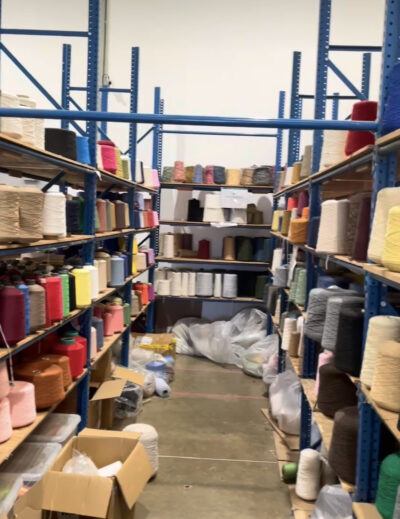
Yeoman Yarns is having a BIG yarn sale! There are shelves of yarn that need to be sold and we’re invited to join them on Tuesday 6th October from 8.30am to 4.00pm. All yarn is £5 per kilo and the address is BHM, Marlborough Drive, Fleckney, Leicester LE8 8UR.

Little boy blue

Dear Anne

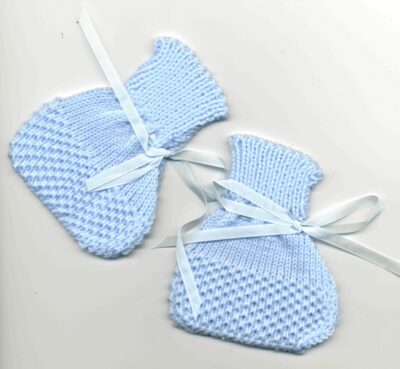
I’ve had your magazine more years than I can remember. Now my children have grown up, are having babies of their own and a new little boy is coming along this year. I remember knitting baby bootees that stayed on, looked good and were ever so quick and easy. I can’t be alone in happily knitting for a new generation. Thank you very much, Emily

BOOTEES

Yarn Any suitable 3-ply.

Machine Brother KH860 with a ribber.

To knit With carriage at right, cast on 41-0-40 sts in 1×1 rib and Tension 0/0. Work zigzag row, insert comb and small weights. Work 1 circular row. Cancel circular. Change to Tension 2/2 and K 1 row to right. Set RC at 000. K 12 rows. Transfer ribber sts to main bed. Change to Tension 5 and K 2 rows. Make a row of holes for ribbon by transferring every alt st to adjacent N. Leave empty Ns in WP. K 2 rows. Inc 1 st at beg of next 11 rows. Carriage on left. Insert Card 1 and lock. Programme machine to read card (KC button on KH860 machine). K 1 row to right. Set card to elongate, left tuck button in, release card and K 15 rows. (You could just work 15 rows in st st.) Dec 1 st at beg of next 8 rows. Cancel patterning (KC button to NL). K 1 row and cast off. Join seam. Thread ribbon and anchor it with a few sewing stitches at centre back, so ribbon can’t come out.

Head cold

Hi Anne

Could you please let us have an easy pattern for an adult balaclava. Most of my back issues are in the loft and I never venture up there in the winter. We live by the sea and it’s the only way I know to shield a man’s face from some of the biting wind. Thanks in advance, Nancy

Here’s a pattern for small, medium and large sizes, Nancy. Use any suitable 4-ply yarn with Tension Dial 7 and 3/3 for the 1×1 rib to give a firm fabric, about 30 stitches and 42 rows to 10 cm.

To knit Cast on 108 [118, 126] sts and K 40 rows 1×1 rib or 80 rows for mock rib. K 2 rows st st. Put 12 sts at each end (*) onto WY or a safety pin. K 60 rows st st. Put 30 sts (**) at each end onto WY or a stitch-holder. K 60 rows (***) st st. Using WY, K a few rows and release from machine.

To make up Refer to the diagram and join A to B by grafting 30 sts (**) onto 60 rows (***). Knit a band to go round the face by casting on 100 sts for all sizes and K 10 rows 1×1 rib or 20 rows for mock rib. Join 12 sts on each side (*) to edges of band, then join neckband at front and sew in ends.

Word of warning

Dear Anne

I’m thoroughly ashamed of myself for forgetting one vital thing when knitting for charity. I work as a volunteer in a soup kitchen and at this time of year, there’s many of us on duty to help, so I decided to knit some old-fashioned but useful pot holders for picking up warm items. As oven gloves were in short supply, one of the cooks used two of my pot holders to lift a large metal pan from the stove. I’d headed for my stash and not taken sufficient care. I’d knitted most of them in wool, but some man-made yarn had crept into the mix. The man-made yarn immediately melted onto the pan. Her quick thinking and actions meant she only suffered slight burns to her hands, but I was absolutely terrified. Please, please print this warning to others. Only use pure wool for pot holders or anything going to war zones, where there will be fire and intense heat. I’ll give you my name, but would you kindly not print it and thank you for spreading the word.

These days, we can find lots of details on line for burn tests for different fibres. In a nutshell, animal fibres such as wool don’t ignite easily, smell like burning hair and leave ash we can crush easily. Man-made fibres melt, smell acrid and form hard plastic beads. Cotton burns quickly, smells like burnt paper or wood and leaves fine, light ash.